Colors and Shapes Activities for Preschoolers: A Simple Daily Routine
Preschool is an exciting stage when children discover the world through colors, shapes, numbers, sounds, pictures, and everyday experiences. Simple activities can help build observation, memory, vocabulary, concentration, and early problem-solving skills. Colors and shapes are particularly easy to introduce because children encounter them in toys, books, household objects, nature, and classroom materials.
Parents do not need complicated lesson plans. A short 10 to 15-minute routine can provide meaningful opportunities for children to explore new concepts while keeping the experience enjoyable.
Why Colors and Shapes Matter
Colors help children describe and identify objects around them. When a child recognizes a red apple, blue ball, or yellow toy, they connect a word with something they can see. Sorting objects by color also introduces basic grouping and comparison.
Shapes provide an early introduction to geometry and visual recognition. Circles, squares, triangles, and rectangles appear in everyday objects, making them easy to demonstrate at home. A clock, plate, window, book, or building block can become a simple example.
Combining both concepts adds another layer of challenge. Asking, “Can you find the red circle?” encourages children to notice color and shape together.
Step-by-Step Activities for Preschoolers
1. Color Hunt
What you need: Toys, books, clothes, or household objects.
Steps:
- Choose one color, such as red.
- Ask your child to find three red objects.
- Let them point to or collect the objects.
- Name each item together.
- Choose another color and repeat.
This simple game develops color recognition and observation.
2. Color Sorting
What you need: Blocks, crayons, toys, or paper pieces.
Steps:
- Place several colorful objects together.
- Create a separate group for each color.
- Ask your child to place each object in the matching group.
- Say the color as each item is placed.
- Mix everything together and try again.
Sorting introduces comparison, organization, and concentration.
3. Shape Hunt
What you need: Everyday objects around the home.
Steps:
- Introduce one shape, such as a circle.
- Show your child a familiar example.
- Ask them to find other objects with the same shape.
- Continue with squares, triangles, and rectangles.
- Talk about where each shape was found.
This connects shape names with familiar surroundings.
4. Shape Matching
What you need: Shape cards or a simple worksheet.
Steps:
- Draw or print circles, squares, triangles, and rectangles.
- Place the shapes where your child can see them.
- Give matching cards or pictures.
- Ask your child to pair each card with the correct shape.
- Name the shape after each match.
Matching supports visual memory and recognition.
5. Color and Shape Challenge
Combine both concepts for a slightly more advanced game.
Steps:
- Choose a color and shape.
- Ask, “Can you find a blue circle?”
- Let your child search among toys or pictures.
- Try combinations such as a yellow triangle or green square.
- Add new combinations as your child becomes comfortable.
This encourages careful listening and following simple instructions.
6. Draw and Color Shapes
Give your child paper and crayons. Draw a circle, square, triangle, and rectangle. Ask them to name each one and color it according to your instructions. Then let them draw the shapes independently.
This combines creativity, shape recognition, color identification, and fine-motor practice.
Create a Simple Daily Routine
A practical routine can be divided into three short sections. Spend five minutes identifying colors or shapes, followed by five minutes of hands-on tasks such as sorting, matching, tracing, drawing, or coloring. Use the final five minutes for a quick recap through questions, stories, or a picture game.
The routine can change according to your child's age and attention span. Familiar tasks can be repeated regularly, while new colors, shapes, or challenges can be introduced gradually.
Add Interactive Activities
Digital resources can complement hands-on experiences when included as part of a balanced routine. Children can explore topics such as ABCs, numbers, colors, shapes, phonics, worksheets, and educational stories through interactive content.
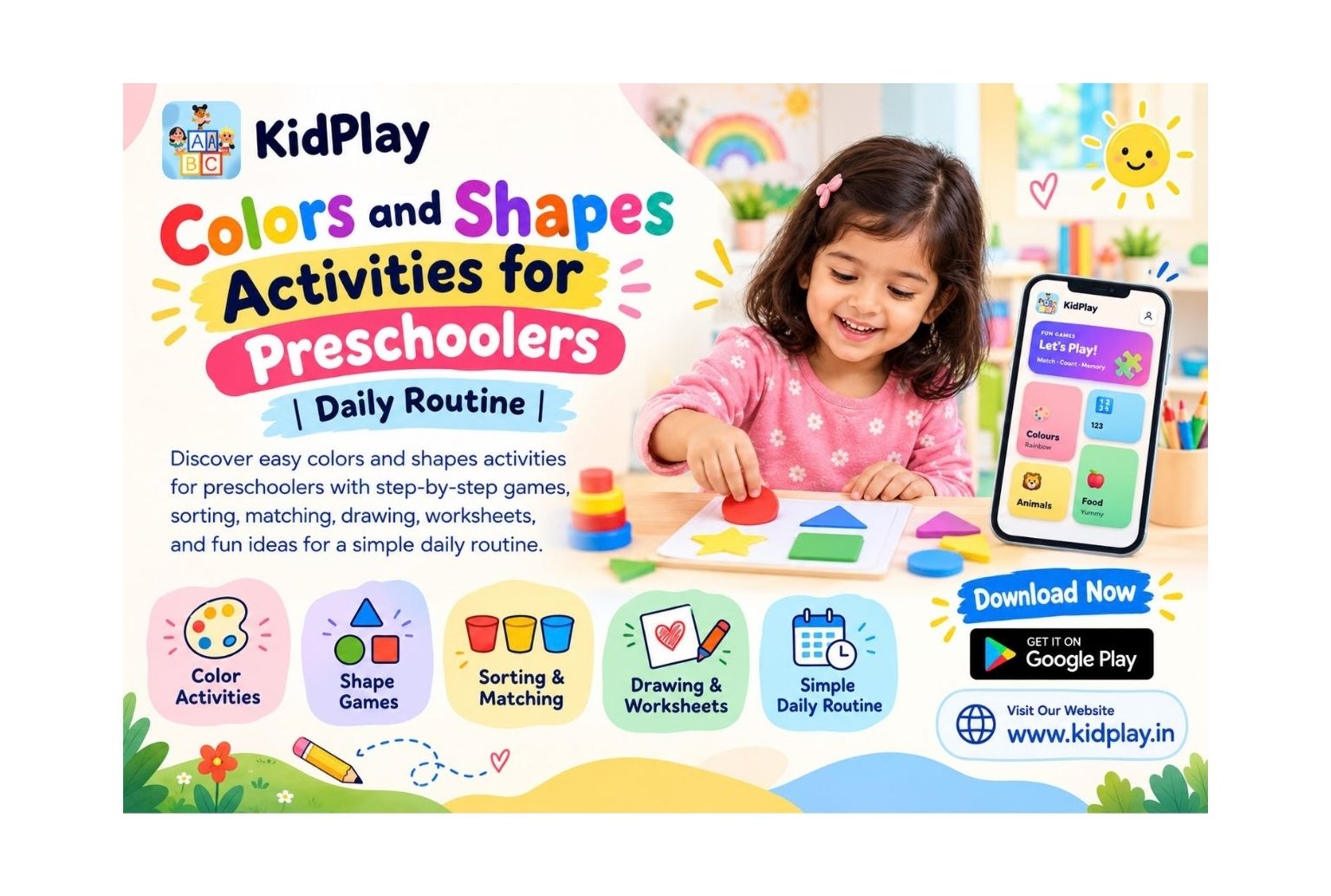
For parents looking to include digital activities alongside books, toys, drawing, and creative play, KidPlay offers an additional option for exploring preschool topics.
Helpful Tips for Parents
Keep instructions short and clear. Give children enough time to answer without rushing them. Encourage effort and curiosity rather than focusing only on getting the correct answer.
You can also turn ordinary moments into simple games. Ask your child to identify the color of a fruit, find a particular shape in the room, or count a few toys before putting them away.
Most importantly, let children enjoy the process. Playful experiences can make new concepts easier to understand and remember.
Frequently Asked Questions
What colors should preschoolers learn first?
Start with familiar colors such as red, blue, yellow, green, orange, and pink.
Which shapes should preschoolers learn?
Circle, square, triangle, and rectangle are useful starting points because children can easily spot them in everyday objects.
How long should a preschool activity last?
Around 10 to 15 minutes can work well for many preschoolers. Adjust the duration according to your child's age and attention span.
How can parents teach colors and shapes at home?
Use toys, household objects, drawing, coloring, sorting, matching, worksheets, stories, and simple observation games.
Can apps support preschool development?
Interactive apps can offer additional opportunities to explore concepts through visual activities, stories, worksheets, sounds, and games.
Give Your Child More Ways to Explore
A balanced preschool routine can combine hands-on play with age-appropriate digital resources. From colors and shapes to ABCs, numbers, phonics, worksheets, and stories, children can discover new concepts through short, enjoyable sessions.
Visit the KidPlay Website | Download KidPlay on Google Play