Preschool is an important stage for developing language, early maths, creativity, and social skills. Children learn naturally through play, exploration, and everyday experiences. Parents can support this development by creating a balanced environment where children discover new concepts without unnecessary academic pressure.
A practical timetable helps families organise the day while leaving enough room for curiosity, relaxation, and independent play.
Why Is Structured Learning Helpful for Preschoolers?
Familiar daily patterns help young children feel secure and gradually develop independence. Activities such as listening to stories, sorting objects, counting toys, and drawing encourage different skills while keeping learning enjoyable.
The goal is not to fill every hour with lessons. Children also need unstructured play, physical movement, interaction with family members, nutritious meals, and adequate sleep. A flexible approach allows parents to respond to their child's changing interests and energy levels.
A Clear Daily Timetable for Preschool Children
The following example combines educational activities with play, meals, and rest. Adjust the timings according to your child's age, sleep schedule, and family commitments.
| Time | Activity | Purpose |
| 7:00–8:00 AM | Wake up, get ready, and eat breakfast | Build independence and healthy habits |
| 8:00–8:20 AM | Alphabet games and letter sounds | Develop early literacy |
| 8:20–8:40 AM | Counting toys and recognising numbers | Introduce basic maths |
| 8:40–9:00 AM | Identify colours and shapes | Strengthen visual recognition |
| 9:00–10:00 AM | Free play and physical activity | Encourage movement and imagination |
| 10:00–10:30 AM | Healthy snack and relaxation | Support rest and self-care |
| 10:30–11:00 AM | Read picture books or tell stories | Improve listening and vocabulary |
| 11:00–11:30 AM | Drawing, painting, or simple crafts | Develop creativity and coordination |
| 11:30 AM–12:30 PM | Independent play and lunch preparation | Explore everyday skills |
| 12:30–2:30 PM | Lunch and nap or quiet time | Allow recovery and relaxation |
| 2:30–3:00 PM | Puzzles, matching, and sorting | Practise problem-solving |
| 3:00–4:00 PM | Snack and outdoor play | Promote physical development |
| 4:00–4:20 PM | Supervised interactive learning | Practise familiar concepts |
| 4:20–6:00 PM | Family time and imaginative games | Encourage communication |
| 6:00–8:00 PM | Dinner, bedtime preparation, and a calming story | Wind down for sleep |
This is a sample schedule, not a strict requirement. Shorten activities when children lose interest, and adapt nap times and bedtime to their individual needs.
Simple Ways to Teach Essential Preschool Skills
Language and early literacy: Introduce letters through songs, picture books, and conversations. Ask children to name familiar objects or describe pictures in their own words.
Numbers and basic maths: Count fruit, toys, stairs, or building blocks together. Sorting objects by size, colour, or shape also introduces early mathematical thinking.
Creativity and problem-solving: Offer crayons, age-appropriate puzzles, building blocks, and pretend-play opportunities. Allow children to experiment rather than expecting every activity to have one correct result.
Communication and social development: Encourage children to express their feelings, ask questions, take turns, and participate in simple family activities. These experiences help build confidence and cooperation.
Add Interactive Learning to the Day
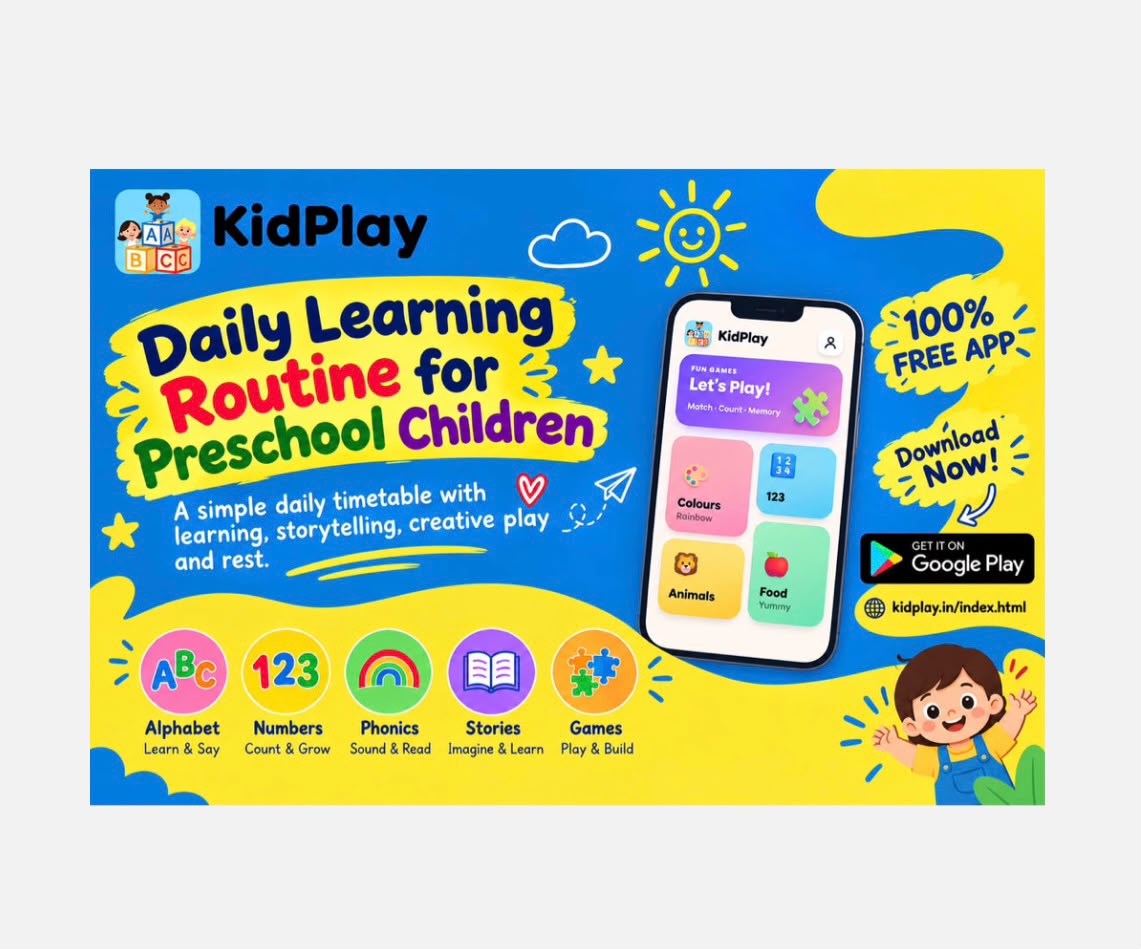
Digital resources can introduce variety when used thoughtfully alongside hands-on activities. KidPlay is a 100 percent free app for kids that parents can explore for early learning concepts, including ABCs, numbers, colours, and shapes.
Explore KidPlay's website for more information.
Tips for Parents
- Follow your child's interests: A favourite animal or toy can become a starting point for counting, drawing, or storytelling.
- Keep expectations realistic: Preschoolers have different attention spans and developmental needs.
- Celebrate effort: Encourage curiosity and persistence instead of focusing on perfect answers.
- Prepare materials in advance: Keep books, crayons, puzzles, and suitable toys within easy reach.
- Allow flexibility: Change an activity when your child needs a break or prefers another form of play.
Small, enjoyable experiences can be more useful than lengthy lessons. Consistency matters, but a family's schedule should remain practical and adaptable.
Frequently Asked Questions (FAQs)
1. What is a good daily timetable for preschool children?
A balanced timetable includes short educational activities, creative play, meals, outdoor movement, family interaction, and sufficient rest. The exact timings depend on the child's age and needs.
2. How can I teach my preschooler at home?
Use everyday objects, songs, picture books, counting games, drawing, and conversations. These activities introduce foundational skills in familiar and engaging ways.
3. Which skills should preschool children learn first?
Focus on communication, listening, recognising letters and numbers, identifying colours and shapes, basic problem-solving, independence, and social interaction. Learning milestones vary between children.
4. Is KidPlay a 100 percent free app for kids?
KidPlay is presented as a 100 percent free app for kids. Parents can check the Google Play listing for current availability and app details.
5. Should preschool children use educational apps every day?
Digital activities are optional. When used, they should be age-appropriate, supervised, and balanced with reading, hands-on play, physical activity, and face-to-face interaction.
Conclusion
Helping preschool children learn does not require complicated lesson plans. A practical timetable, creative play, storytelling, and everyday conversations can build essential skills while making learning enjoyable.
👉 DOWNLOAD KIDPLAY ON GOOGLE PLAY