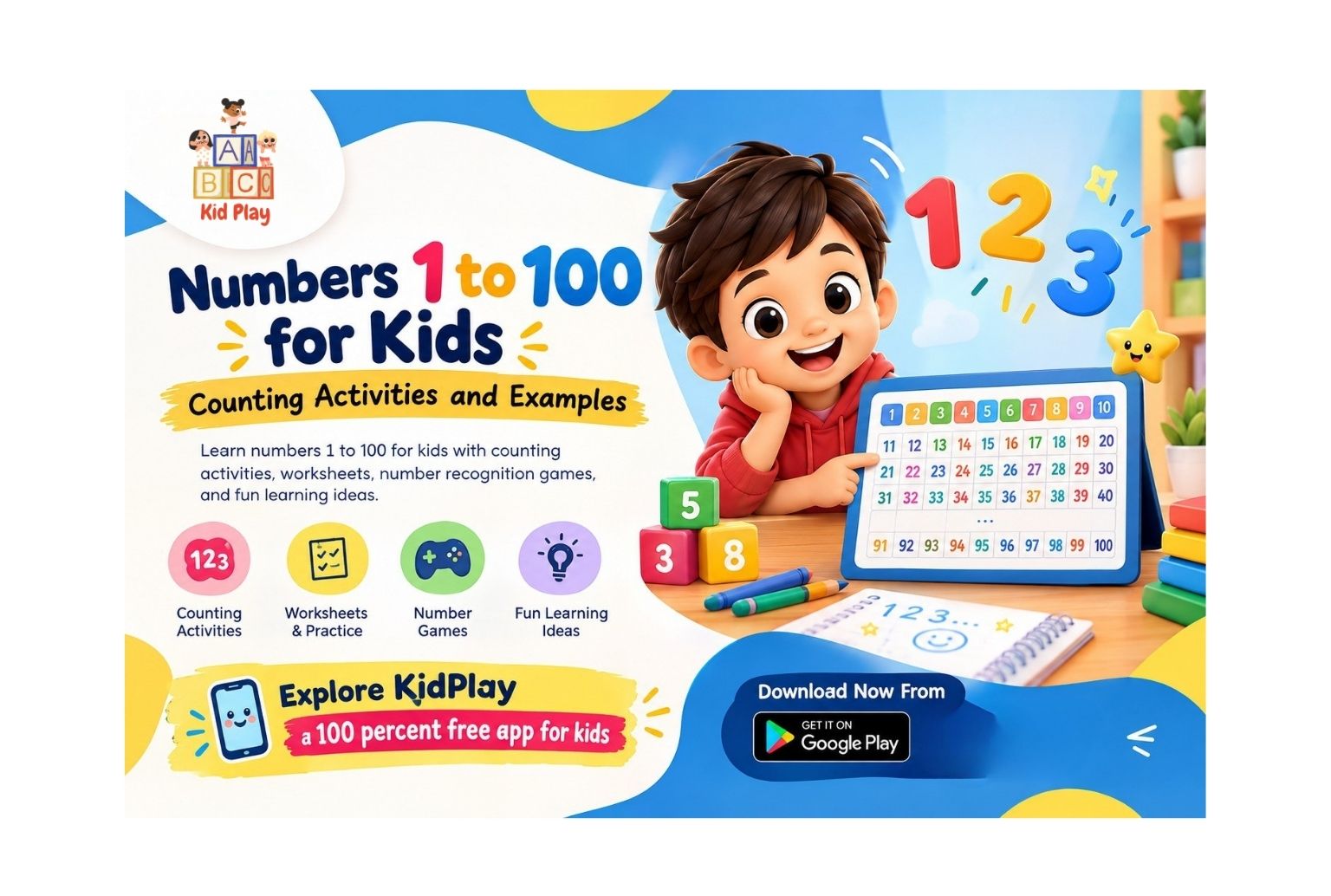
Learning numbers 1 to 100 is an important step in early childhood education. For preschool and kindergarten children, counting develops number recognition, sequencing, and basic mathematical understanding. Parents can make this process enjoyable through colourful number charts, counting games, worksheets, and interactive learning activities.
Children learn effectively when they connect numbers with familiar objects and everyday experiences. Practising a little each day helps them recognise numerals, count confidently, and prepare for school mathematics.
Why Should Kids Learn Numbers 1 to 100?
Learning numbers helps children understand quantities, compare objects, and recognise numerical patterns. Start with numbers 1 to 10, gradually progressing to 20, 50, and eventually 100. Children can practise counting aloud, identifying numerals, and understanding that each number follows another in a sequence.
Kindergarten learners can also explore missing numbers, number ordering, and counting groups of objects. Every child learns differently, so parents should introduce new numbers gradually and celebrate progress.
Five Fun Counting Activities for Kids
1. Count Everyday Objects: Use pencils, toys, books, fruits, or building blocks. Ask your child to count each object aloud while touching it. This activity connects numbers with real quantities.
2. Number Recognition Cards: Write numbers on separate cards and ask children to identify the number you call out. Begin with familiar numerals before introducing larger numbers.
3. Missing Number Game: Write sequences such as 11, 12, __, 14 or 36, __, 38. Encourage children to identify the missing number and explain the sequence.
4. Count and Move: Ask children to clap five times, jump three times, or take ten steps while counting. Movement adds excitement and encourages active participation.
5. Counting Worksheets: Introduce worksheets featuring number tracing, picture counting, matching exercises, and missing-number puzzles. Short activities help children practise without feeling overwhelmed.
Numbers 1 to 100: Examples for Children
Learning numbers in smaller groups makes counting easier. Practise these number ranges daily:
- 1–10: One, two, three, four, five, six, seven, eight, nine, ten.
- 11–20: Eleven, twelve, thirteen, fourteen, fifteen, sixteen, seventeen, eighteen, nineteen, twenty.
- 21–30: Twenty-one to thirty.
- 31–40: Thirty-one to forty.
- 41–50: Forty-one to fifty.
- 51–60: Fifty-one to sixty.
- 61–70: Sixty-one to seventy.
- 71–80: Seventy-one to eighty.
- 81–90: Eighty-one to ninety.
- 91–100: Ninety-one to one hundred.
Ask children to count forward, identify selected numerals, and write numbers they recognise. Once they understand the sequence, introduce skip counting by twos, fives, and tens.
Make Early Learning Interactive with KidPlay
Digital learning can complement hands-on counting when parents choose suitable educational content. KidPlay provides early-learning resources covering numbers, ABCs, colours, shapes, animals, worksheets, educational stories, and interactive activities.
Parents searching for a 100 percent free app for kids can explore KidPlay to support foundational learning through playful digital experiences. Combine these resources with physical counting games, conversation, and regular practice for a balanced approach.
Explore the KidPlay official website or download KidPlay from the Google Play Store to discover learning resources for young children.
A Simple Daily Counting Routine
A short routine makes number practice manageable for busy families. Try this ten-minute schedule:
- 2 minutes: Count aloud from 1 to 20.
- 3 minutes: Identify numbers using flashcards or a number chart.
- 3 minutes: Complete a worksheet or interactive counting activity.
- 2 minutes: Count household objects and revise familiar numbers.
Adapt the routine to your child's interests and attention span. Repeat challenging numbers patiently and encourage independent attempts.
Tips for Parents and Teachers
Display a number chart where children can see it regularly. Practise counting toys, snacks, books, and steps during everyday activities. Introduce new concepts gradually and revisit familiar numbers through games.
Balance digital activities with drawing, movement, conversation, and hands-on practice. Choose age-appropriate resources, supervise young children, and maintain reasonable screen-time limits. Focus on understanding rather than memorising numbers quickly.
Frequently Asked Questions
1. How do I teach numbers 1 to 100 to kids?
Start with small number groups and gradually introduce larger numbers using charts, flashcards, objects, and counting games.
2. Which counting activities are suitable for kindergarten?
Picture counting, number matching, tracing worksheets, missing-number puzzles, and counting everyday objects are useful activities.
3. How can children improve number recognition?
Regularly practise identifying numerals, matching numbers with quantities, and arranging number cards in sequence.
4. Can educational apps help children learn numbers?
Yes. Interactive activities and visual resources can supplement practical learning when combined with parental guidance.
5. What does KidPlay offer for early learning?
KidPlay features learning resources covering numbers, ABCs, colours, shapes, animals, worksheets, educational stories, and interactive activities. Visit its official website for details.
Conclusion
Learning numbers 1 to 100 becomes enjoyable when children combine counting games, worksheets, number recognition, and everyday practice. Consistent encouragement helps develop confidence and foundational mathematics skills.
Give your child a playful start to learning today! Visit the KidPlay website or download KidPlay from Google Play to explore early-learning activities for preschool and kindergarten children.