Young children learn new words by observing pictures, listening to sounds and connecting objects with everyday experiences. Picture-based learning activities make vocabulary development enjoyable by helping preschoolers recognise objects, understand meanings and practise speaking. From identifying animals and colours to learning letters and shapes, visual activities provide an engaging foundation for early language development.
Why Is Picture-Based Learning Important?
Pictures provide visual clues that help children understand and remember unfamiliar words. When a child sees an apple while hearing the word “apple,” the connection between the object and its name becomes clearer. Repeating this experience strengthens recognition and understanding.
Visual learning also encourages children to ask questions, describe objects and express their thoughts. These activities support listening, observation, memory and communication skills. For toddlers and preschoolers, learning through pictures makes new concepts easier to explore.
7 Picture-Based Activities to Build Early Vocabulary
Show children pictures of familiar objects, such as a chair, ball, cup, book or spoon. Say each word clearly and encourage them to repeat it. Then ask them to find the same object at home. This activity connects pictures with real-life experiences and introduces useful everyday vocabulary.
2. Learn Animal Names and Sounds
Display pictures of cats, dogs, elephants, lions, birds and cows. Ask children to name each animal and imitate its familiar sound. Questions such as “Which animal says meow?” encourage children to connect words with visual clues while making learning entertaining.
3. Identify Colours Through Pictures
Use colourful pictures of fruits, toys, clothes and household objects. Ask questions such as “What colour is the banana?” or “Can you find something blue?” Repeat the activity with different objects to help children recognise colours in their surroundings and develop observation skills.
4. Explore Shapes and Their Names
Introduce pictures of circles, squares, triangles and rectangles. Help children identify these shapes in everyday objects, such as clocks, windows and books. Encourage them to describe what they see using simple words and sentences.
5. Build Vocabulary with Alphabet Pictures
Connect letters with familiar objects, such as A for apple, B for ball and C for cat. Ask children to name each picture and listen to its beginning sound. This activity supports letter recognition, vocabulary development and early phonics awareness.
6. Play Picture Matching and Sorting Games
Prepare picture cards featuring fruits, animals, vehicles, toys and food. Ask children to match identical pictures or group related objects. For example, a bus, car and bicycle belong in the vehicle category. Sorting activities introduce category names and help children understand relationships between words.
7. Create Stories Using Pictures
Arrange three or four pictures showing a simple sequence, such as planting a seed, watering it and watching a plant grow. Ask children what happens first, next and last. Encourage words such as “small,” “green” and “growing.” Picture storytelling supports vocabulary, sentence formation and imagination.
How Digital Learning Supports Vocabulary Development
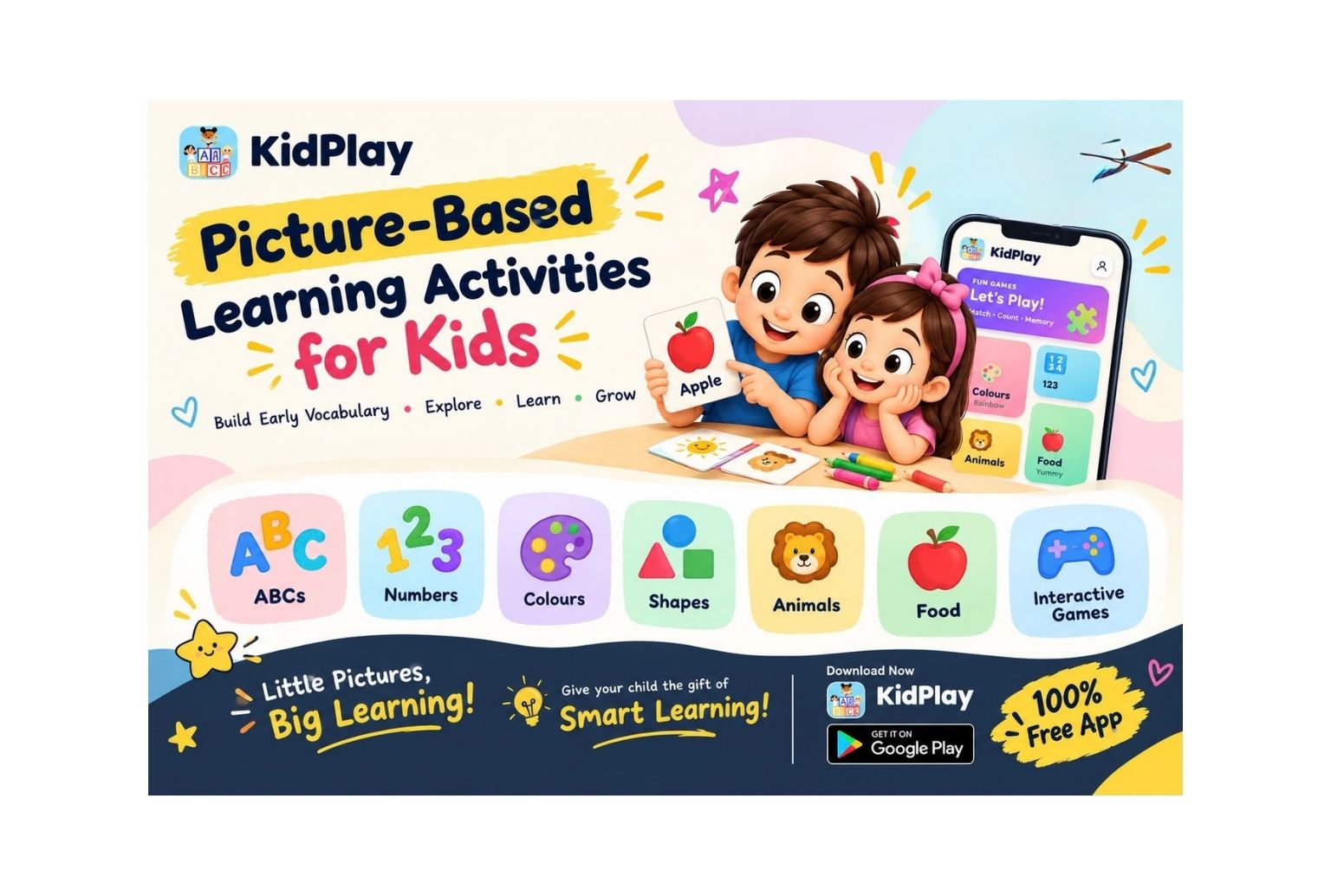
Digital activities can complement picture books, flashcards and hands-on games. KidPlay provides learning resources related to ABCs, numbers, colours, shapes, animals, worksheets, stories and interactive activities for young children.
Explore engaging learning activities with KidPlay. Visit the official KidPlay website or download the app from Google Play. It is a 100 percent free app for kids, offering families an accessible way to explore early learning at home.
Frequently Asked Questions
1. What are picture-based learning activities?
These activities use images, illustrations and visual cards to teach children words, objects and concepts. Examples include animal identification, colour recognition, alphabet pictures and matching games.
2. How do pictures improve vocabulary in preschoolers?
Pictures connect words with visual meaning, helping children recognise objects, remember names and practise speaking. Repetition and conversation reinforce learning.
3. Which pictures are best for teaching toddlers new words?
Start with familiar objects, animals, fruits, vehicles, toys and colours. Introduce a few words at a time and repeat them through playful activities.
4. Can educational apps help develop early vocabulary?
Yes. Age-appropriate educational apps can complement books, conversations and hands-on learning. Parents should balance digital activities with offline play.
5. Is KidPlay a free learning app for children?
Yes. KidPlay is a 100 percent free app for kids featuring learning resources covering ABCs, numbers, colours, shapes, animals, stories, worksheets and interactive activities.
Conclusion
Picture-based learning activities offer a simple way to build early vocabulary and communication skills. Naming everyday objects, identifying animals, exploring alphabet pictures and creating stories help children connect words with their surroundings.
Make vocabulary practice part of your child's daily routine through conversations, creative games and interactive learning. Visit the KidPlay website or download KidPlay on Google Play to explore learning activities for young children.