Children discover language through everyday conversations, colourful illustrations and playful experiences. When parents introduce new words using familiar pictures, children can connect what they see with what they hear. This makes visual learning games for kids a useful addition to early childhood education.
From identifying fruits and animals to describing actions and recognising shapes, picture vocabulary games encourage children to observe, listen and communicate. Parents can introduce these experiences at home using flashcards, storybooks, toys and interactive educational games.
How Do Visual Learning Games Develop Vocabulary?
Visual learning activities connect pictures with spoken words, helping children understand their meanings through familiar examples.
For instance, showing a picture of a butterfly and discussing its colours, wings and movements introduces several related words. Children gradually learn to describe objects rather than simply memorising names.
These vocabulary building activities for preschoolers can support:
- Word recognition: Identifying familiar objects and their names.
- Speaking skills: Practising words and short sentences.
- Observation: Recognising colours, shapes and differences.
- Listening: Following simple questions and instructions.
- Memory: Remembering vocabulary through repeated activities.
Regular conversations and playful repetition make these experiences more meaningful.
6 Creative Vocabulary Games for Preschoolers
1. Guess the Picture Game
Show children a partially covered picture of an animal, fruit or household object. Reveal small sections and encourage them to guess what it represents.
For example, display part of a banana and ask, "What could this yellow fruit be?"
This picture vocabulary activity encourages observation, word recall and communication.
2. Describe What You See
Choose illustrations featuring parks, classrooms, playgrounds or family activities.
Ask children questions such as:
- What is the boy holding?
- How many birds can you see?
- What colour is the bicycle?
Encourage simple descriptions such as "The bird is flying" or "The girl has a red bag."
These preschool speaking activities introduce action words, descriptive vocabulary and basic sentence formation.
3. Find the Opposite
Use picture pairs to introduce opposite words such as big and small, happy and sad, hot and cold, or open and closed.
Show two contrasting illustrations and ask children to explain the difference.
These early language development activities help children understand descriptive words through visible comparisons.
4. Picture and Object Treasure Hunt
Prepare pictures of familiar household items, including a spoon, pillow, book, bottle and chair.
Ask children to find the matching objects around the room.
When they discover an item, encourage them to name it and explain how it is used.
This toddler vocabulary activity connects words with everyday surroundings while developing listening and observation skills.
5. Build Sentences with Action Pictures
Introduce pictures showing children running, eating, reading, jumping or drawing.
Begin with individual action words before encouraging short sentences.
For example:
Picture: A child reading.
Word: Reading.
Sentence: "The child is reading a book."
Gradually introducing longer descriptions can support speaking confidence and early language development.
6. Sort Pictures into Categories
Collect pictures representing animals, vegetables, vehicles, clothes and toys.
Encourage children to organise them into different groups and explain their choices.
For example, carrots, potatoes and tomatoes can be grouped as vegetables.
These interactive learning games for kids introduce category vocabulary while encouraging comparison and problem-solving.
Age-Wise Vocabulary Activities for Children
Children develop language skills at different rates. Parents can adjust activities according to their child's interests and abilities.
| Age Group | Suggested Activities |
| 2–3 years | Naming familiar objects, identifying animals and recognising pictures |
| 3–4 years | Matching pictures, describing colours and learning action words |
| 4–5 years | Creating short sentences, sorting categories and telling simple picture stories |
These preschool learning activities are flexible suggestions rather than fixed developmental expectations.
How Can Educational Apps Support Early Learning?
Digital learning activities for kids can complement physical books, storytelling and parent-child conversations.
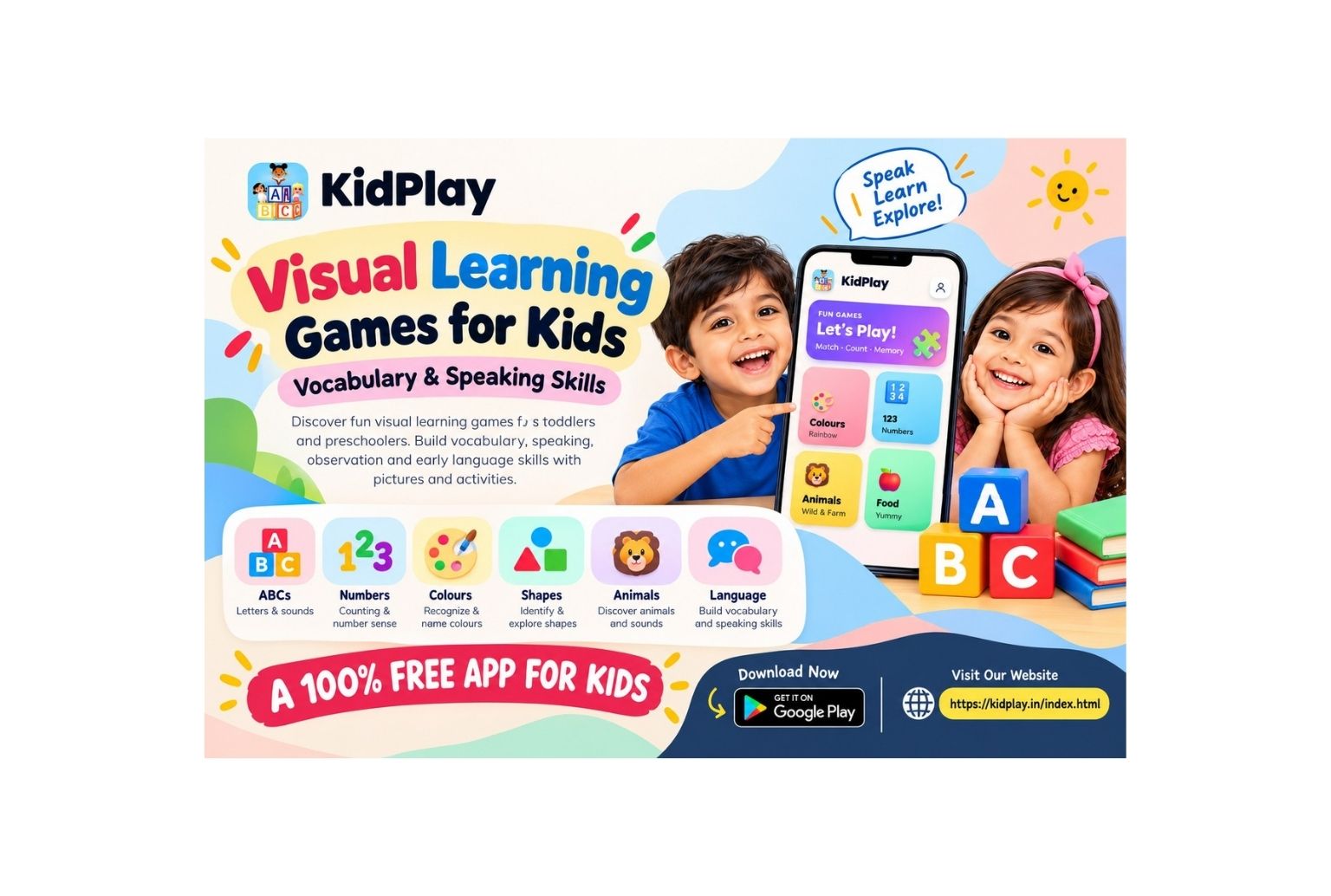
KidPlay offers educational resources covering ABC learning games, numbers, colours and shapes learning, animal recognition games, stories, worksheets and interactive activities.
As a 100 percent free app for kids, it gives families another way to explore foundational learning concepts.
Parents can combine short, supervised digital sessions with offline games to encourage active participation.
Explore preschool learning activities: Visit the KidPlay website or download the app on Google Play.
Simple Daily Vocabulary Practice Routine
A short, enjoyable routine can help children revisit familiar words while discovering new ones.
| Duration | Activity |
| 5 minutes | Name pictures and everyday objects |
| 5 minutes | Play matching or sorting games |
| 5 minutes | Describe illustrations or tell stories |
| 5 minutes | Practise new words through conversation |
Parents can shorten or extend activities depending on the child's attention and interest.
Frequently Asked Questions
1. What are visual learning games for preschoolers?
Visual learning games for preschoolers use pictures, illustrations and matching activities to introduce vocabulary, colours, shapes, objects and basic concepts.
2. How can parents improve children's vocabulary at home?
Parents can read picture books, describe everyday activities, ask simple questions and encourage children to use new words during conversations. Vocabulary learning games can provide additional practice.
3. Which vocabulary activities are suitable for toddlers?
Naming familiar objects, recognising animals, identifying body parts and matching simple pictures are useful toddler vocabulary activities.
4. Do picture games help children develop speaking skills?
Yes. Picture-based learning games provide opportunities to name objects, answer questions and describe actions. Regular interaction with adults supports language development.
5. Can digital learning games replace traditional activities?
No. Educational learning games for kids work best as complementary resources alongside reading, conversations, outdoor exploration and hands-on play.
Conclusion
Developing early vocabulary does not require complicated teaching methods. Simple vocabulary building activities involving picture guessing, sentence building, object matching and storytelling can make language learning enjoyable.
By introducing new words through familiar experiences, parents can encourage children to communicate, observe and express their ideas.
For additional early learning games and preschool activities, explore the KidPlay website or download KidPlay on Google Play and make playful learning part of your child's routine.